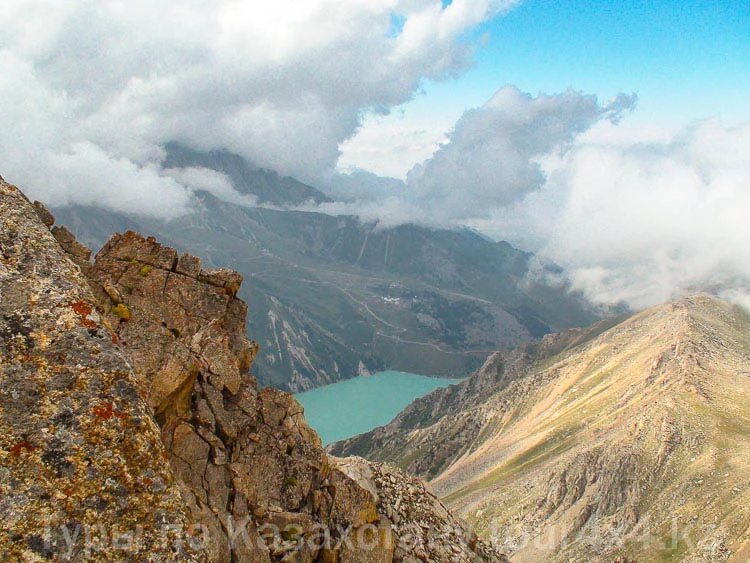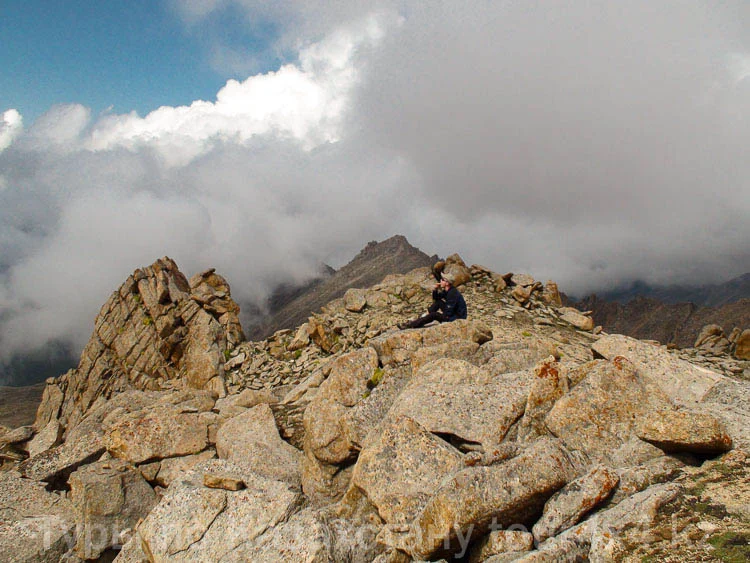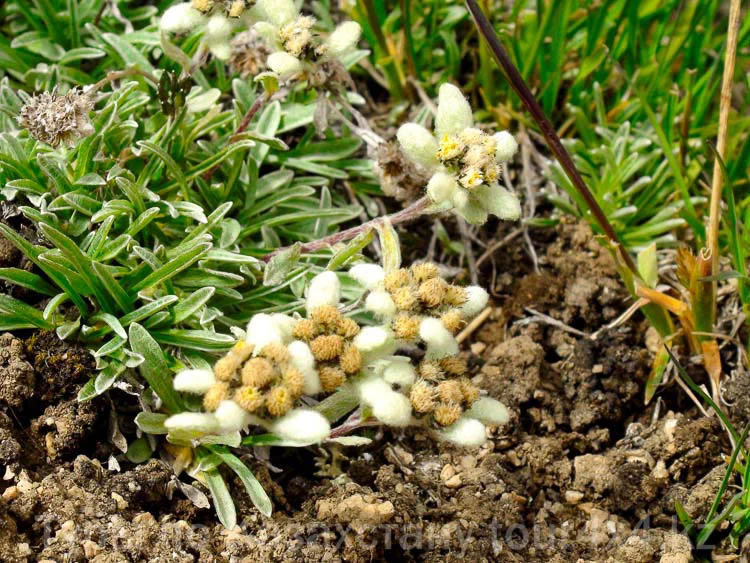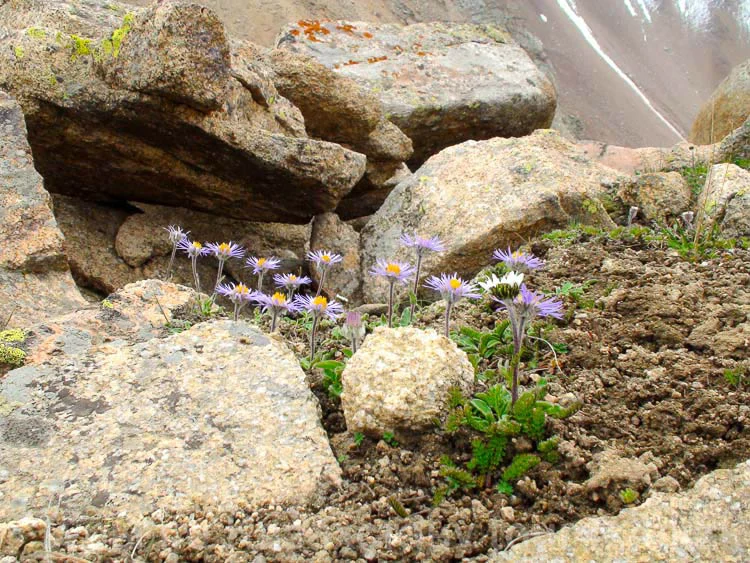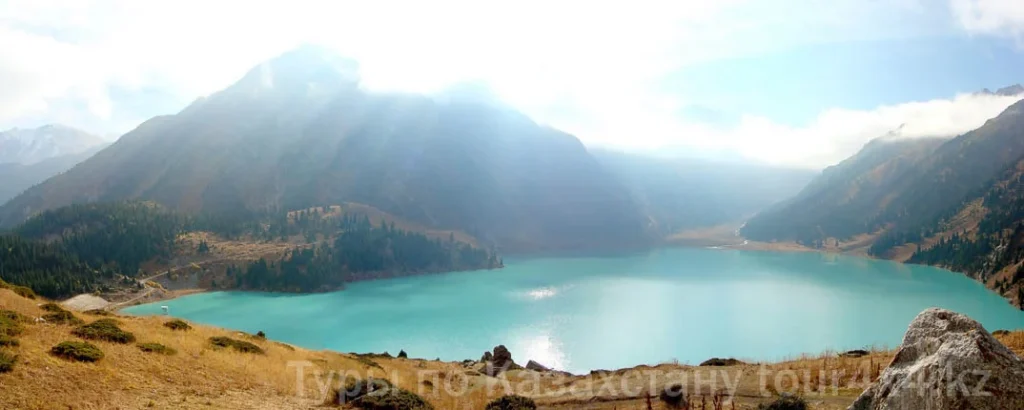
The Big Almaty Gorge has long been a favorite recreation spot for Almaty residents. It is far more spacious than the other gorges near the city, and at an altitude of 2,500 meters above sea level it is adorned with the unique Big Almaty Lake.
Big Almaty Lake.
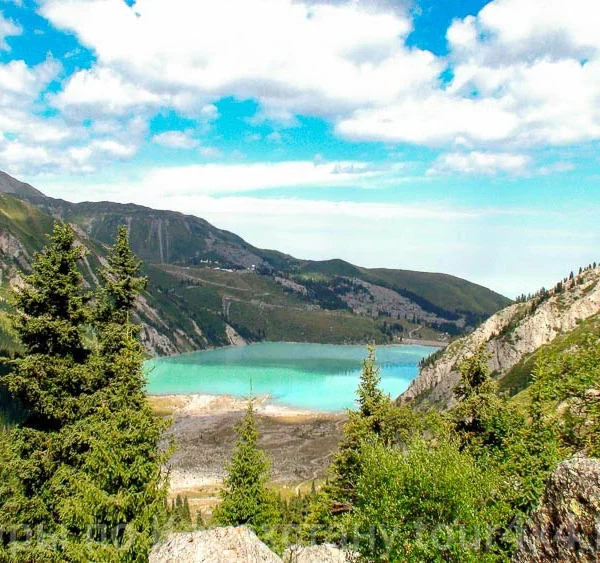 This gorge is always a little cooler than the others, owing to the low temperature of the lake reservoir. But before you reach the lake, you will be able to admire the natural beauty of the Trans-Ili Alatau. Turning off the city highway into the gorge, you will drive past numerous restaurants and cafes huddled together on both sides of the road. You pass the barrier dam and arrive at the environmental post — here the National Park zone begins.
To the right of the road, next to this post, is the so-called falconry ground, where ornithologists breed endangered species of birds of prey. It is an interesting place to visit, but our goal today is different. A little further past the post, there is a left turn off the main highway — the road along the Kazachka River leads to the Kum-Bel restaurant and hotel complex, and beyond it you can walk to Kok-Zhailau via a very popular mountain trail. Our route first follows the wide valley along the Big Almaty River. To the left of the road, traces of a powerful mudflow that swept through here in 1977 are still visible; it lost its force because the gorge is wide — the mudflow simply spread across its lower part and never reached the city. Still, many bridges and several structures and houses in the lower part of the gorge were destroyed. The entire river valley was buried under a mud-and-stone mass, and the road that exists today was built right on top of the former mudflow. Later, a protective dam was constructed.
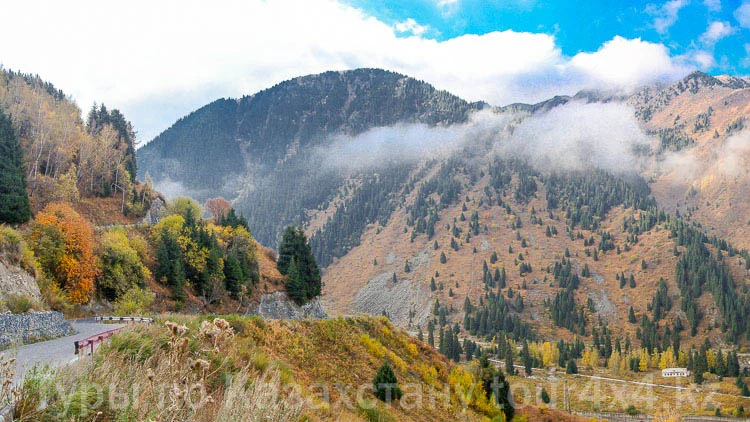 The road winds in steep serpentines, and you can admire the slender Tien Shan spruces on the northern slopes of the gorge, while the southern slopes are almost treeless and covered with sparse shrubs. There is also a beautiful birch grove. The road was reconstructed in 2009-2010 and driving along it is now a real pleasure. We pass the road split — one branch goes into the Alma-Arasan Gorge, while ours heads right and onward. Another place well known to Almaty residents is the Ayu-Sai (Bear) Gorge, where brown bears lived until the late 1950s. But road construction and the growing noise of civilization made them gradually move to quieter places, and now these animals can only be seen in the Talgar Reserve. Several small hydropower stations have been built in the gorge, using the force of water flowing from the lake to generate electricity.
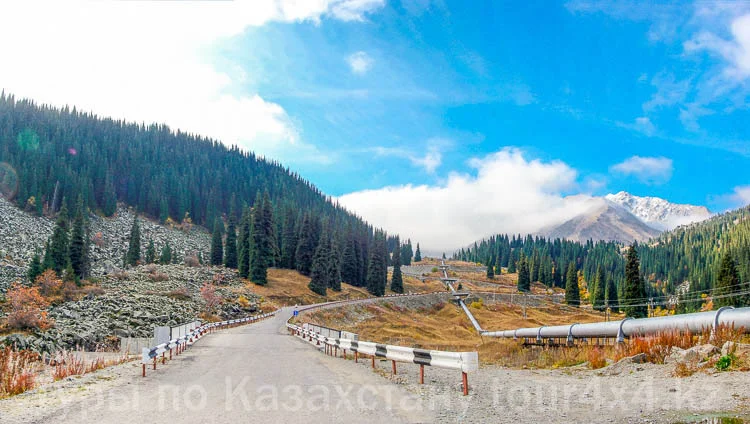
The road keeps climbing higher and higher, the landscape changes, and the slopes reveal more and more huge moss-covered boulders — these are ancient moraine heaps shifted into vast mountain folds in time immemorial. According to scientists, more than 2,000 years ago a devastating earthquake literally moved the mountains here. As a result of this natural cataclysm, a natural dam formed, blocking the water’s path. A giant bowl 38 meters deep filled with the purest mountain water. Even on hot summer days, the water temperature in the lake does not exceed +12 degrees Celsius.
And now you arrive at the dam, which was later raised and reinforced by people, so that now, when completely full, the water rises above 50 meters. This water is used not only to drive the turbines of the power stations, but also for the needs of the city.
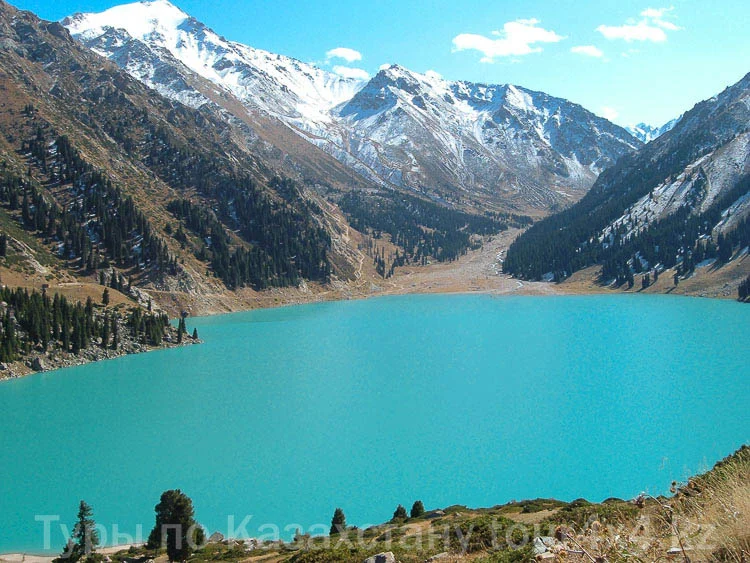 The most beautiful view of the lake opens up further up, if you drive two more turns along the road — there it is, below, in all its emerald glory. The water is at its richest color in late summer and early autumn, when it is no longer murky and has settled. Around the lake rise four-thousand-meter peaks with white glaciers. If you do not speak loudly, you can always hear the murmur of the Ozernaya River, which brings its waters to the western shore of the lake.
This research station was founded in 1957 as a small expedition from Moscow State University, and by 1962 it had grown into a permanent observation station. And no wonder — only three places on Earth have such a large amount of open sky: the Andes, the Pyrenees and our Trans-Ili Alatau. So celestial objects can be observed almost all year round. Many northerners would envy us, residents of Almaty — we have 85% of sunny days a year!
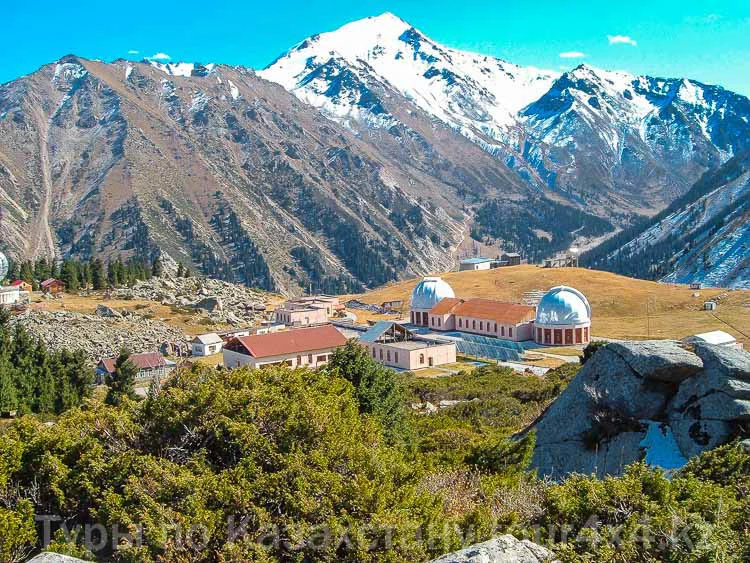 Along the lake and further on, the road leads over the Ozerny Pass to the turbulent Chon-Kemin River. Since ancient times, this has been the start of a tourist route to Lake Issyk-Kul in Kyrgyzstan. You are now at about 2,600 meters and, leaving your vehicle, you can take a leisurely walk further along the road. Some 20 minutes into the walk, you will see the domes of the telescopes of the Tien Shan Astronomical Observatory named after V.G. Fesenkov.
But the road leads even further, up to an altitude of 3,330 meters, to the Zhusaly-Kezen Pass, home to another research station, known to many as the Cosmic Station. Here, physicists study cosmic particles using various equipment, including even underground laboratories. The station’s staff have made several scientific discoveries in the field of physics.