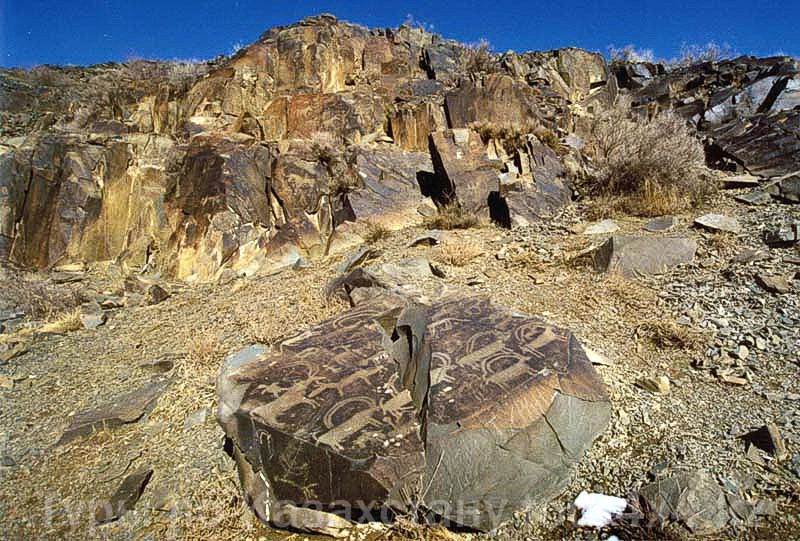
The Tamgaly tract is located 170 km northwest of Almaty, in the southeastern part of the Chu-Ili Mountains, which stretch from south to north from the Zailiysky Alatau to Lake Balkhash and the Betpak-Dala desert. The geographical position and nature of Chu-Ili have since ancient times determined the direction of the seasonal migrations of large herds of animals (saigas, kulans) and, later, the routes of many peoples settling across the expanses of Asia. At this peculiar crossroads of ancient roads, already in the Bronze Age, more than 3000 years ago, there arose a mountain sanctuary with thousands of petroglyphs that, by the design of their creators, adorned the rock surfaces of the small Tamgaly canyon.
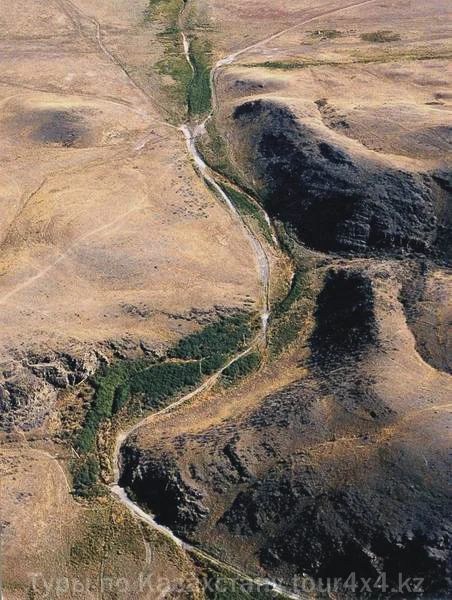 The Chu-Ili Mountains lie in a desert zone with an arid, sharply continental climate; today this is one of the sparsely populated areas of Semirechye. There are few rivers here, and many of them dry up in summer; in the hot season only the brackish water of springs and pools provides people and animals with moisture. There are no forests here, and solitary trees are rare, but the mountain slopes are covered with dense shrubs. The sparse grass vegetation becomes brighter and richer in spring, clothing the mountains and plains in the variegated colors of flowers. With the onset of the summer heat the vegetation quickly yellows, and until late autumn only the floodplain of the Tamgaly River retains the greenery and freshness of an oasis. Tamgaly is home to rare plant species found only in the Chu-Ili Mountains and listed in the Red Book of Kazakhstan – Regel’s tulip, Kushakevich’s juno and others, which require special protection. Among the wild animals here are wolves, foxes, hares, tortoises and snakes, as well as numerous birds, including birds of prey – the steppe eagle, the red-footed falcon and the saker falcon. The deserted and seemingly uninhabited world of the desert is filled with life and a special beauty. The picturesque relief of the Tamgaly tract took shape over the long geological history of the Chu-Ili Mountains. The main role in this process was played by neotectonic movements, the youngest of which are about 1 million years old. The boundary between the mountains and the broad plain that spreads out north of Tamgaly marks the line of an ancient fault, as a result of which the earth’s surface was once uplifted and a high escarpment formed; water and wind erosion completed the shaping of the river valleys that made their way through the chain of low mountains with dome-shaped and flat summits (a landscape of low hills).
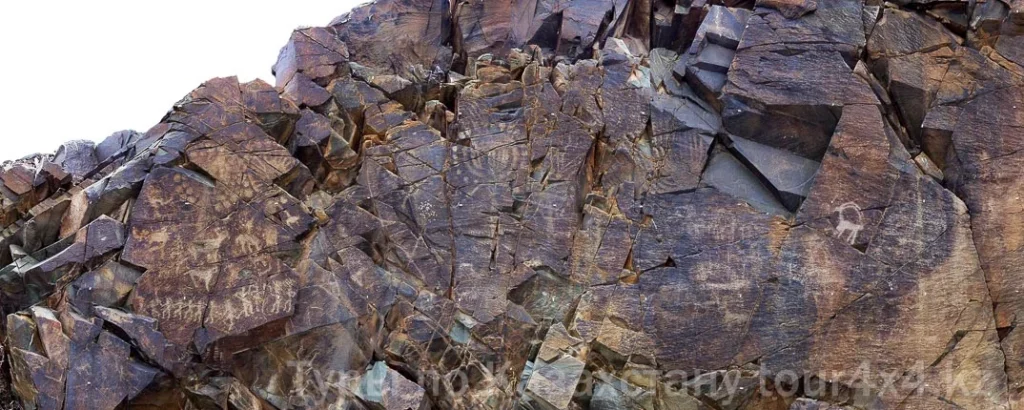
The most striking attraction of Tamgaly is a small canyon formed at the mouth of the gorge. Here, on the fanciful bends of the valley, the rocky slopes at times come right up to one another, forming an almost enclosed space. The broad, smooth rock surfaces have over many millennia become covered with “desert
varnish”, making an ideal backdrop for this gallery created by no human hand, in which more than one generation of ancient masters – the creators of the rock art – labored. For centuries, for the different peoples who left their mark on the history of Kazakhstan, the rocks of the canyon and the narrow Tamgaly valley retained the significance of a sanctuary – a place where ritual ceremonies were held, magic rites performed, and homage paid to gods and ancestral spirits. The tradition of veneration lives on at Tamgaly to this day: it is clearly attested by the colorful scraps of fabric tied to the branches of shrubs and by other simple “offerings” of modern pilgrims.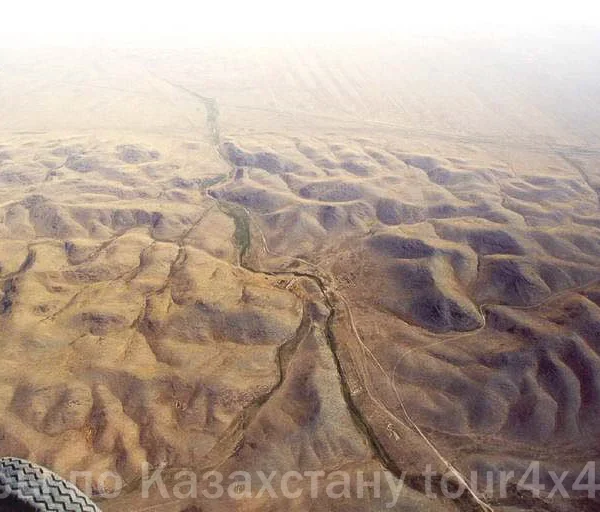
About a hundred different monuments are known at Tamgaly – settlements, burial grounds, altars and petroglyphs dating from the Bronze Age, the Early Iron Age, the Middle Ages and the modern era. Concentrated within a comparatively small area, together they form an archaeological complex that embodies the history of many ancient and modern peoples of Kazakhstan over three millennia.
The most ancient inhabitants of Tamgaly were the Bronze Age tribes of the Andronovo culture, who inhabited the lands of Kazakhstan in the 2nd millennium BC. The origin of these tribes remains a matter of debate, but their connection with the Indo-Iranians – herders and farmers, skilled metallurgists and masters of swift war chariots – is considered the most likely. The first inhabitants of Tamgaly, having chosen this picturesque spot, transformed the natural world around them: in creating petroglyphs, setting up dwellings or stone tombs, they impressed upon the landscape their own vision of the order of the world. For the generations of successive peoples – the Saka and the Wusun, the ancient Turks and their descendants, the Kazakhs – this inner orderliness of Tamgaly was perceived as a heritage of the ancestors and was preserved, hallowed by tradition.
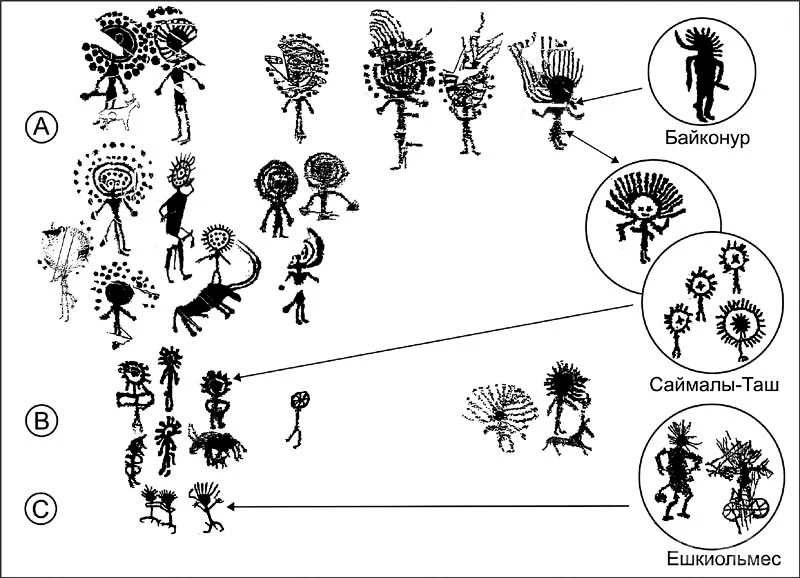
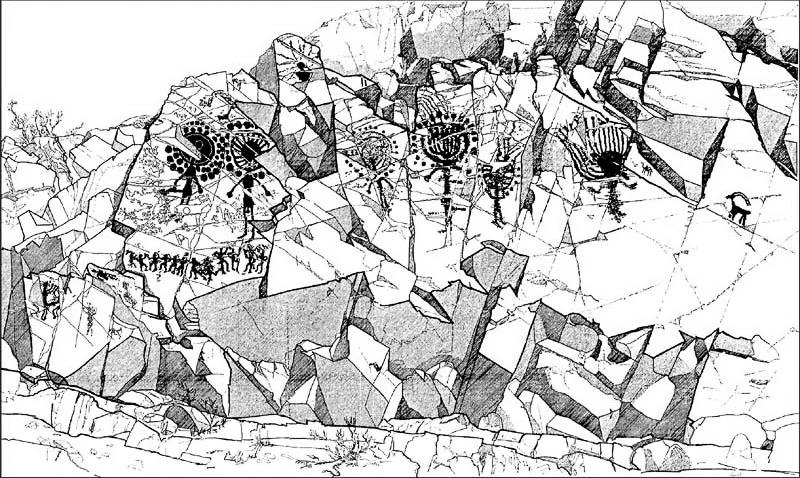
The core of the complex at all times was the canyon, on whose rocks, conventionally designated as groups I-V, about 3000 petroglyphs have survived. Close by, at the foot of a solitary hill, lies an extensive necropolis, where the most ancient burials were made in the 14th-13th centuries BC; on the piedmont plain, the burial mounds of nomads of the 1st millennium BC – 1st millennium AD stand out in separate groups, including a mound with stone ridges known as “mustaches”. This entire territory, including the canyon with its petroglyphs, has from the most ancient times been a ritual zone, within which people did not live and which they visited for ceremonial purposes.
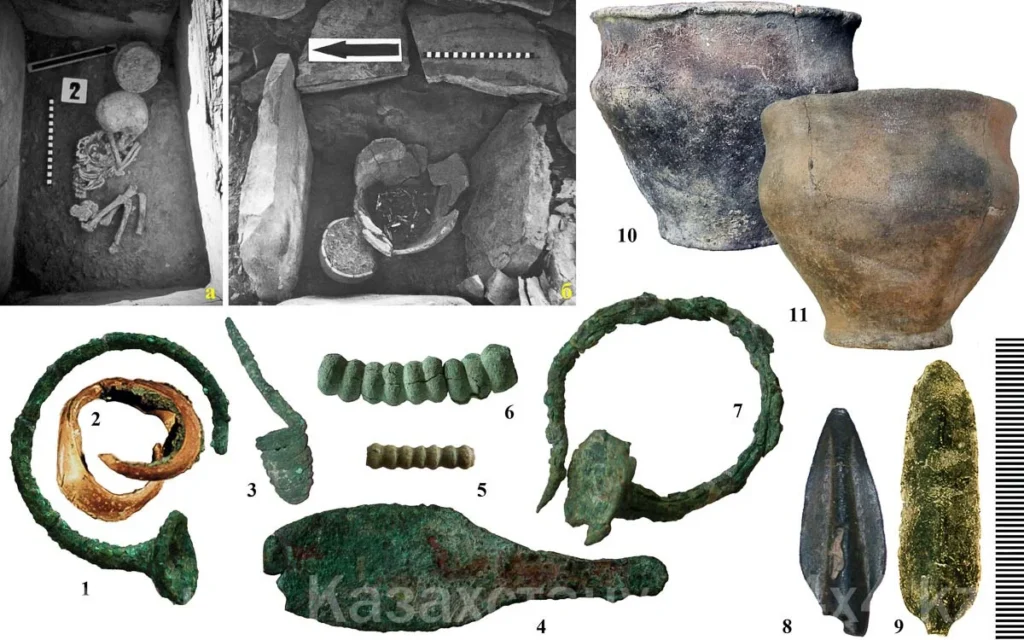
The everyday life of the inhabitants of Tamgaly took place on the periphery of the tract; it is here that archaeologists find the remains of ancient settlements and campsites. Settling in clans and families, people chose convenient sites in small intermontane valleys, where springs were close at hand and the hilltops sheltered them from winter winds and, of course, from sudden raids. The mountain conditions of the tract limited the choice, which is why many sites once settled by people continued to be used by subsequent generations. Gradually the old buildings turned into ruins and were covered with earth, and new ones arose in their place. Thus, at the Tamgaly I settlement, the remains of a stone dwelling with a hearth inside, built at the end of the Bronze Age (12th-10th centuries BC), were found buried under a three-meter layer of earth that had accumulated as a result of almost continuous habitation here until the end of the 19th century. Far from all the monuments of Tamgaly have been thoroughly studied, and many questions therefore remain unanswered.
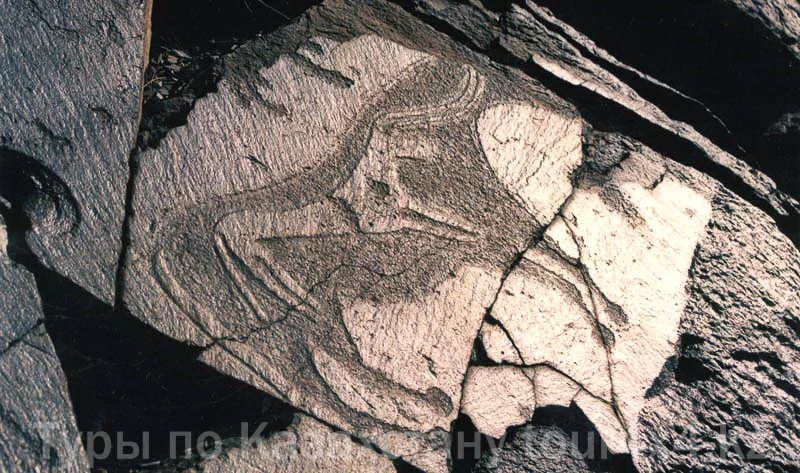
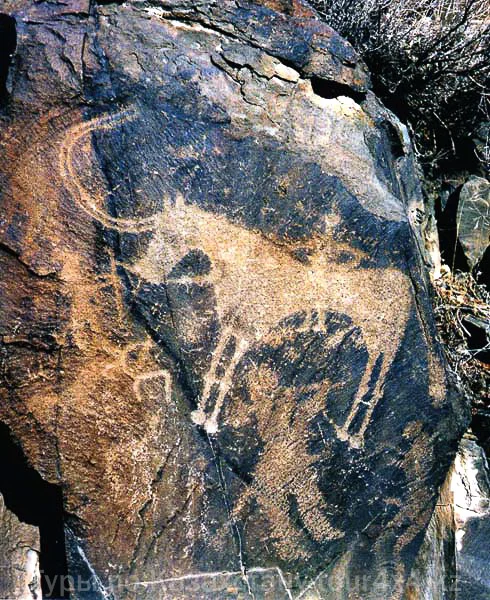
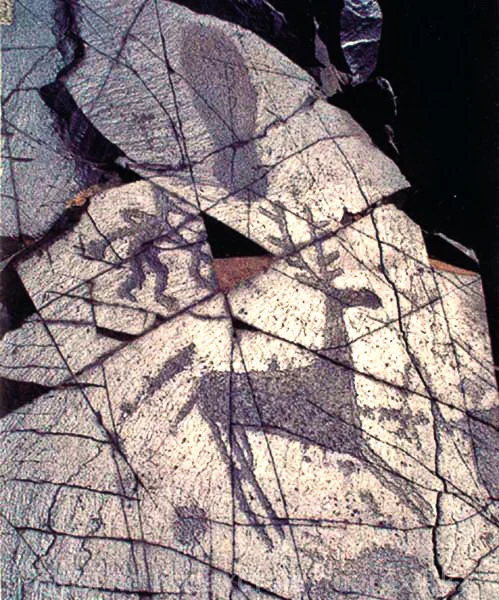
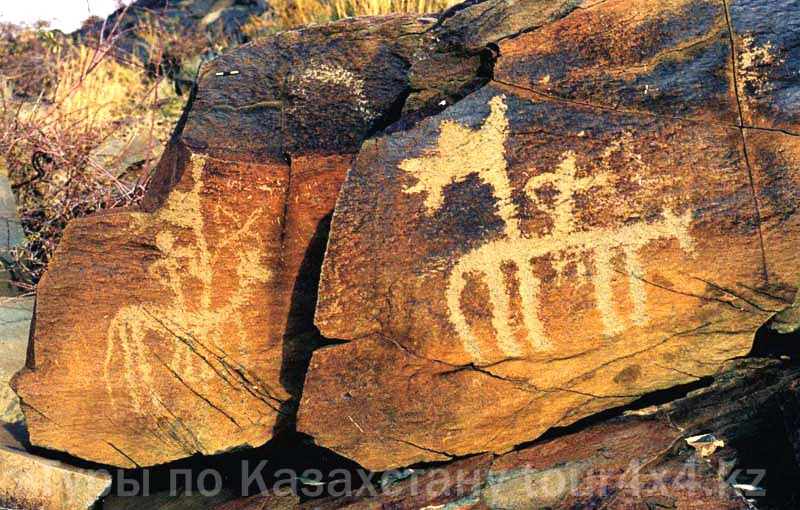
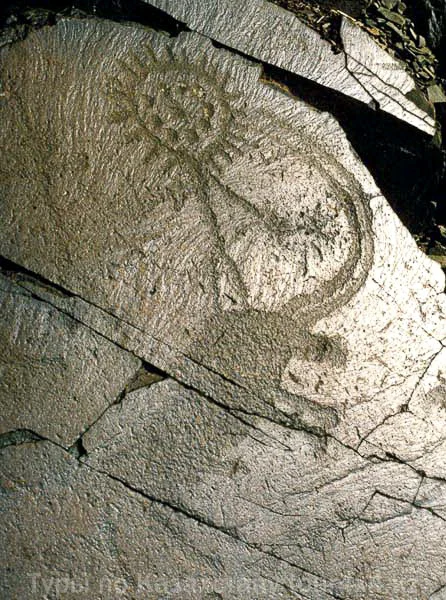 The petroglyphs of Tamgaly are the most important scholarly source and, moreover, possess enormous artistic value. The creators of the ancient drawings skillfully exploited the phenomenon of “desert varnish” — a very thin layer of patina covering the rock surface and formed by oxides of magnesium, manganese and iron, as well as by colonies of particular species of microorganisms. The master artist, with strong blows of a stone or metal tool, removed the layer of patina along the outline of the drawing, achieving the desired effect: the light image stood out in sharp contrast against the dark background of the rock. But with time, after centuries, the images once again became covered with “desert varnish”, the drawing darkened and was lost against the background of the rocks. The brightness of a drawing could be restored only by striking off the patina once more, that is, by renewing the petroglyphs.
At Tamgaly one can sometimes see images carved on a single rock surface that differ markedly in color; as a rule, the darkest petroglyphs, barely distinguishable on the surface, are the most ancient, while the medieval and modern drawings look much lighter. Often petroglyphs made at different times overlap one another; such multilayered compositions (called palimpsests) and the color of the patina help to determine the relative age of the drawings.
The age of the Tamgaly petroglyphs can be established more precisely thanks to drawings found on building stones from ancient graves and dwellings studied by archaeologists: by dating the burials and settlements using radiocarbon analysis or objects characteristic of one era or another, the age of the drawings themselves is determined. Finds of images on the walls of Bronze Age graves helped establish the time when the most ancient petroglyphs of the sanctuary were created: the end of the 14th-13th centuries BC.
The age of the petroglyphs can also be judged from depictions of real weapons or items of clothing whose existence in one era or another is established from other sources. For example, horse-drawn chariots as a form of military transport appeared among the tribes of Kazakhstan in the Bronze Age in the 16th-15th centuries BC, but already by the beginning of the 1st millennium BC they had lost their importance with the mastery of riding and the spread of cavalry. The appearance of stirrups, the rigid saddle, the pike and the sabre accompanied the conquests of the ancient Turkic tribes in the 1st millennium AD.