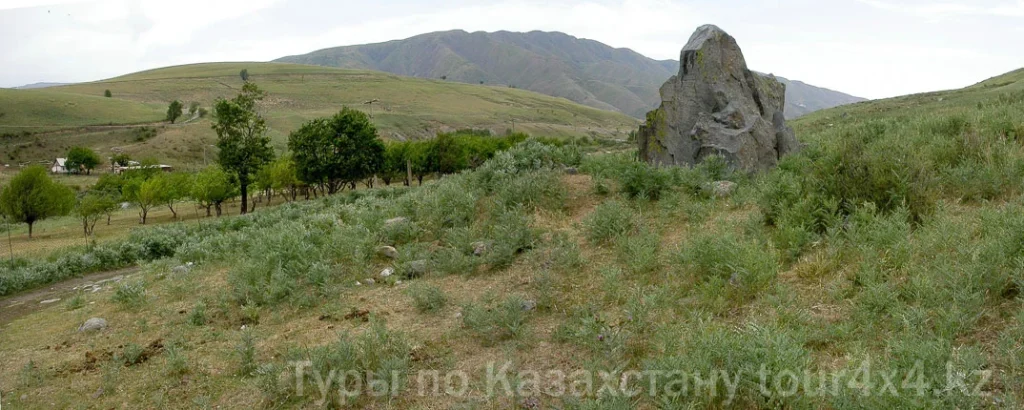
A monument of monumental Tibetan art and epigraphy, second half of the 17th century. It is located on the north-eastern outskirts of the town of Tekeli, at the mouth of the gorge on the right bank of the Kora River, a right tributary of the Karatal River. It was first surveyed in 1898 by N.N. Pantusov, who produced a description and photographs and recorded its local name – Kelinshektas (“daughter-in-law stone”). In 2008 it was surveyed by an expedition of the Kazakh Research Institute for the Cultural Heritage of Nomads (headed by I.V. Erofeeva and A.E. Rogozhinsky); a modern translation of the epigraphic texts was made by N.S. Yakhontova (Institute of Oriental Manuscripts of the Russian Academy of Sciences, Russia).
The monument is a complex structure: on a round stone platform (8 m in diameter, up to 1.5 m high) built of large river boulders stands a block of grey sandstone (base 3.0 x 4.2 m, height 3.6 m), on the upper and side (western) faces of which inscriptions and images are carved. To the north of the platform a stone paving of pebbles, shaped like a ramp, can be discerned. In the centre of the platform, on the western side of the monument and beneath it, there is a 19th-century robber pit up to 1 m deep. To the east of the monument there are 5 stone-and-earth mounds 8-10 m in diameter and up to 1 m high.
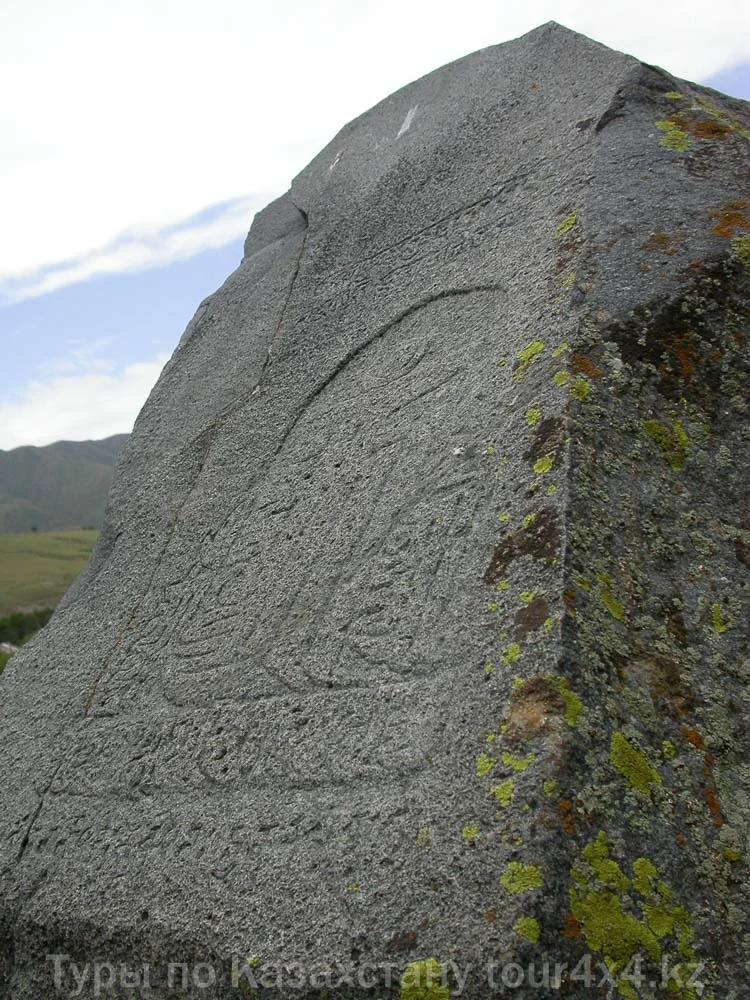
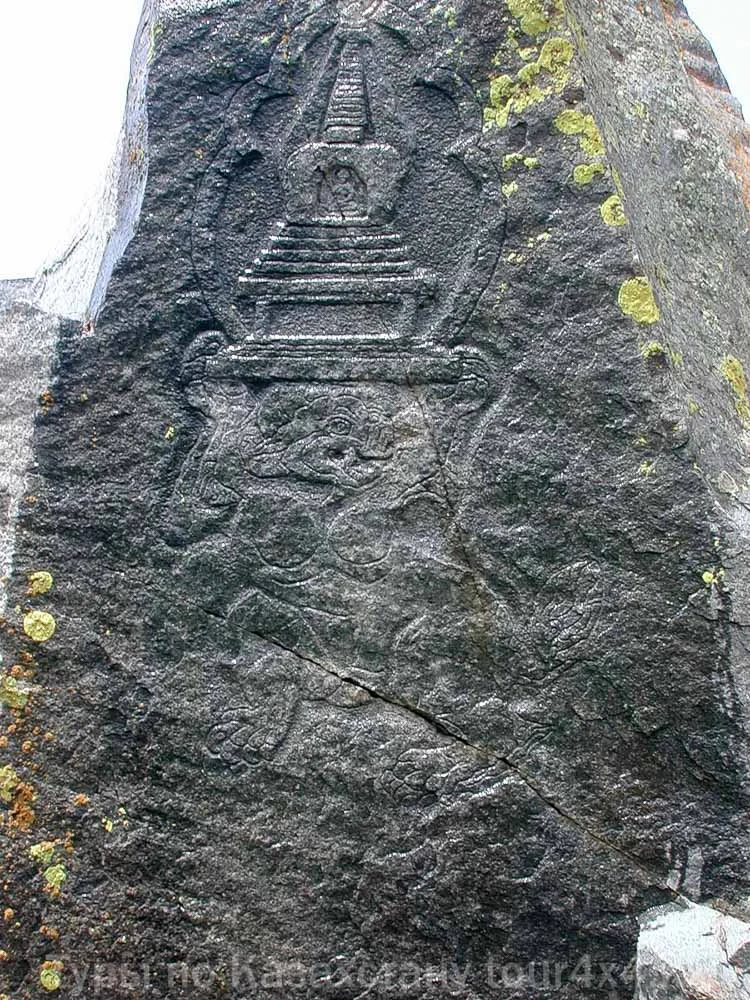
The surface of the upper face of the monument, which slopes to the west (73 x 60 x 51 cm), was pre-treated. On it inscriptions executed in bas-relief and deep carving can be discerned. In the centre is the image of the Buddhist symbol “kalachakra”; the inscription, made from top to bottom in the “lantsa” script (Tib. lantsa), contains the symbolic syllables: ham, ksah,ma, la, va,ra, ya. To the left and right are two more symbols written in vertical script; at the bottom is a horizontal line of text in the “lantsa” script. Above and below the “kalachakra” there are two horizontal lines of Tibetan text. The upper line contains a plea for deliverance from diseases and epidemics; the lower is a rendering in Tibetan letters of a mantra in Sanskrit: om ta mo ni pha tah rgyun na pasva ha. On the western face of the stone there is a bas-relief depicting a fantastic beast on its hind legs holding above its head a stupa with the figure of the seated Buddha Shakyamuni inside.