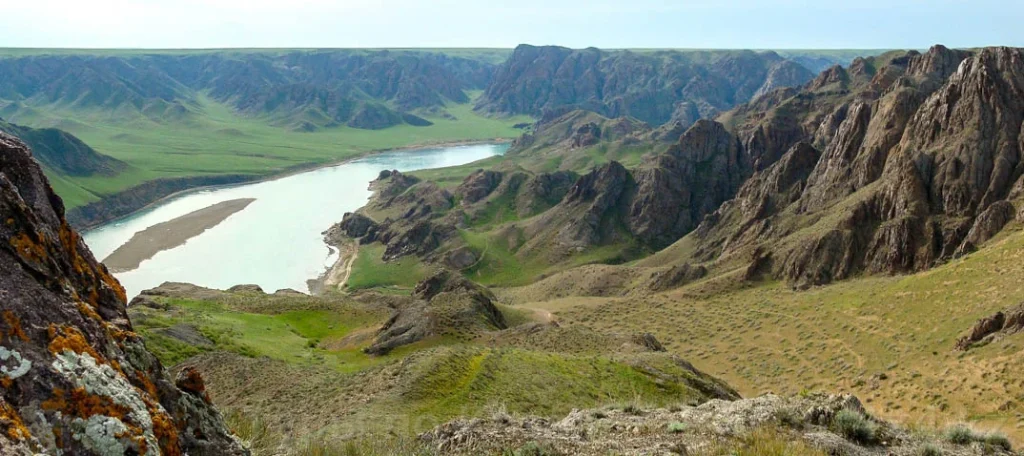
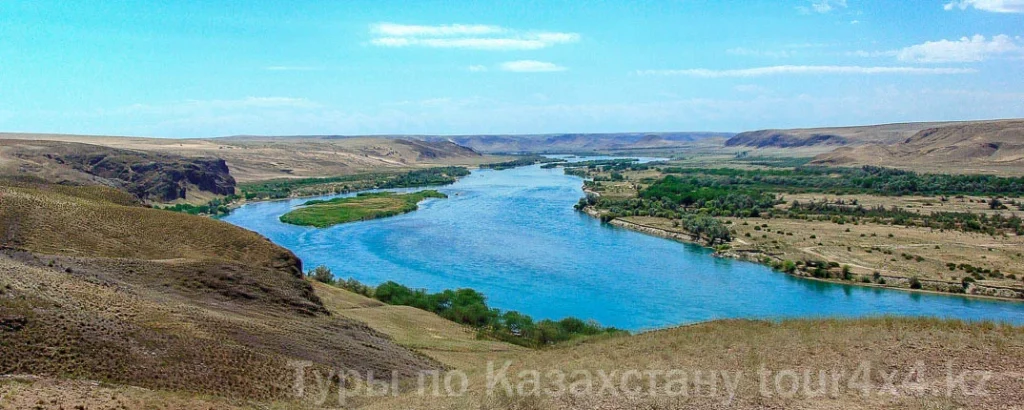
At the 95 km mark, the pavement gives way to a dirt road, and here you will understand the expression “dust rising in pillars”. After some 30 minutes of driving you will find yourself on a sort of hillock, from which a wonderful view opens up over the rocky canyons and the green-blue ribbon of the river. On sunny spring days the air is filled with the scent of vermouth — that is the fragrance of young wormwood. The place is simply a born photo model! Foreigners call it “Kazakh Arizona”. I do not know what Arizona is like, but ours is beautiful.
Then you will continue along a steep descent across clean sand, where you can spot a turtle, a monitor lizard, a little lizard or a snake. After the descent the road turns left: the Ili River valley on your right, and gentle hills with rocky outcrops covered in flowers and blossoming shrubs on your left. The final destination of the journey is a large rock massif that has served alpinists and rock climbers as a venue for training and competitions for many years. So you will be able to watch this interesting sight as well.
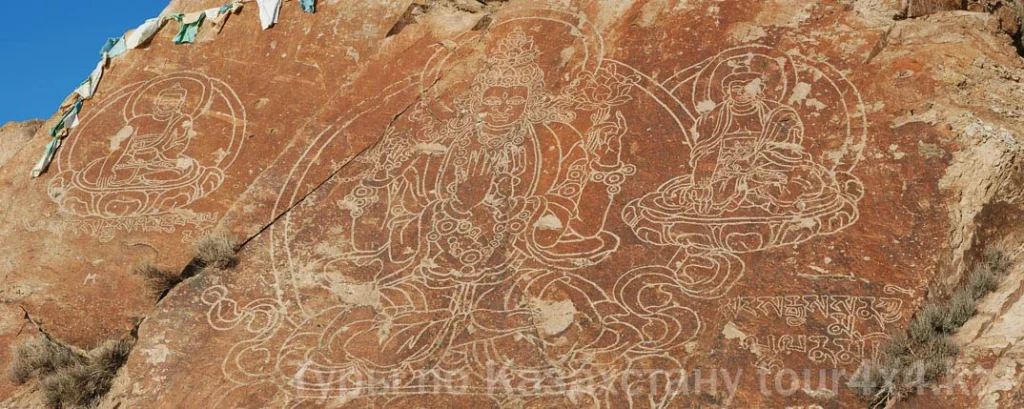
Here you leave your vehicle and walk along the rock massif upstream. On a large ochre-red rock, as if on a huge natural canvas, the central part of the complex is depicted — Buddha Shakyamuni and two Burkhans (attendants) — Man-La and Chon Ray Chik. Their names are written beneath the images. A little lower, to the left of this canvas, a Burhan with snakes is depicted on a separate stone. This is a guardian deity; the snakes around his head are drawn horned — they are mythical serpents. According to Buddhist belief, the snakes will not let a person with evil intentions approach the center of the complex as a shrine. Ignorance and unwillingness to improve oneself were likewise considered among the chief evils, an obstacle on a person’s path to truth. Burhan Chon Ray Chik (he stands in the center, his image is larger, he is many-armed and his robes are richly ornamented) is “he who cuts the bonds of ignorance”, while the Burhan on the right is “the keeper of wisdom”.
The composition is completed by the image of Buddha Shakyamuni himself, in the left part of the monolith — modestly depicted, greeting the worthy with a kind smile. The delicate stone-carving technique impresses: the restraint and precision of the drawing, the elegance of the lines.
Below this complex, a little further on almost beside the road, stands a separate image of Buddha, with untranslated texts next to it. Some inscriptions of the complex are believed to contain the Buddhist prayer formula “Om mani padme hum”. Judging by the style of the inscriptions, scholars suggest this image appeared somewhat earlier than the main complex.
The drawings and inscriptions of Tamgaly-Tas were first surveyed and described as early as the mid-19th century by the outstanding Kazakh scholar Ch. Valikhanov. He compiled a description of the monument and sketched its images and inscriptions. Many scientists and researchers of later times turned to them as well. The dating of the drawings raised many questions, but the accepted version is that this composition was created during the reign of the Dzungar khan Erdeni Batur Khuntaiji, when a truce agreement (1646–1650) was concluded between the Kazakh khan Zhangir and the Dzungar Erdeni Batur. It was precisely in that period that images of the Burkhans and Buddha spread.
Nowadays Tamgaly-Tas has become a mass tourism destination and, unfortunately, this sometimes leads to the barbaric destruction of the monument. It urgently needs protection and restoration.
After viewing the historical monument, I recommend stepping inside the rock massif and walking through the small valley surrounded on all sides by cliffs, which rock climbers call “the harbor”. Then follow a clearly visible steep path up and to the right to climb the rocks. From there a truly impressive panorama opens up: the river valley, hills stretching into the distance, and far to the right, on the opposite bank, stands a model of a medieval Asian castle. It remained after the filming of the movie “Nomad” and has since taken root in these parts.



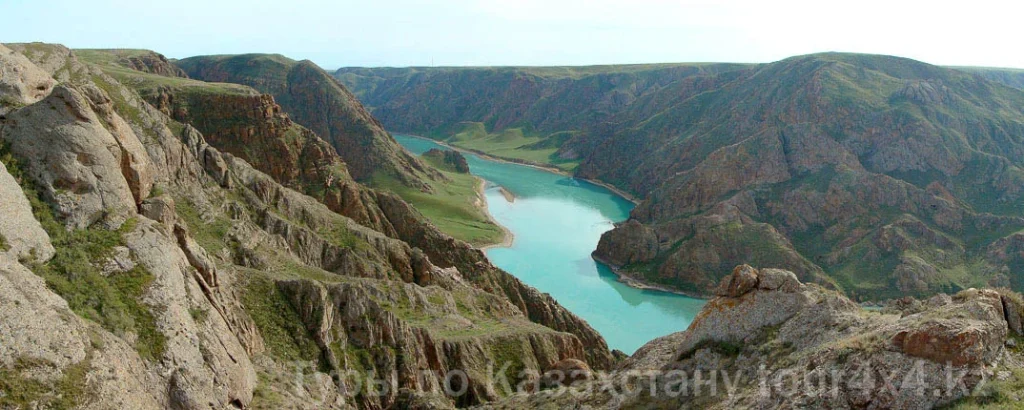
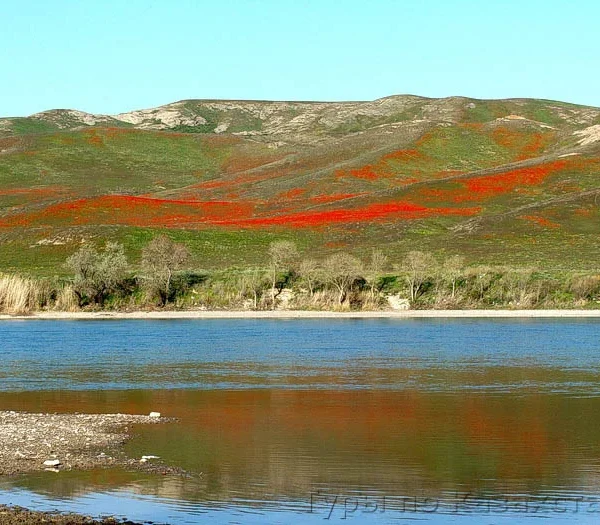 A trip to the Pisanyye Skaly (Painted Rocks), as this place is sometimes called, is best made in April–May, when the steppe is bustling with life, the song of larks fills the air, yellow-orange tulips are scattered along the road, and a little later, in May, poppies cover the surroundings with a red carpet. This bountiful season in the steppe passes very quickly.