



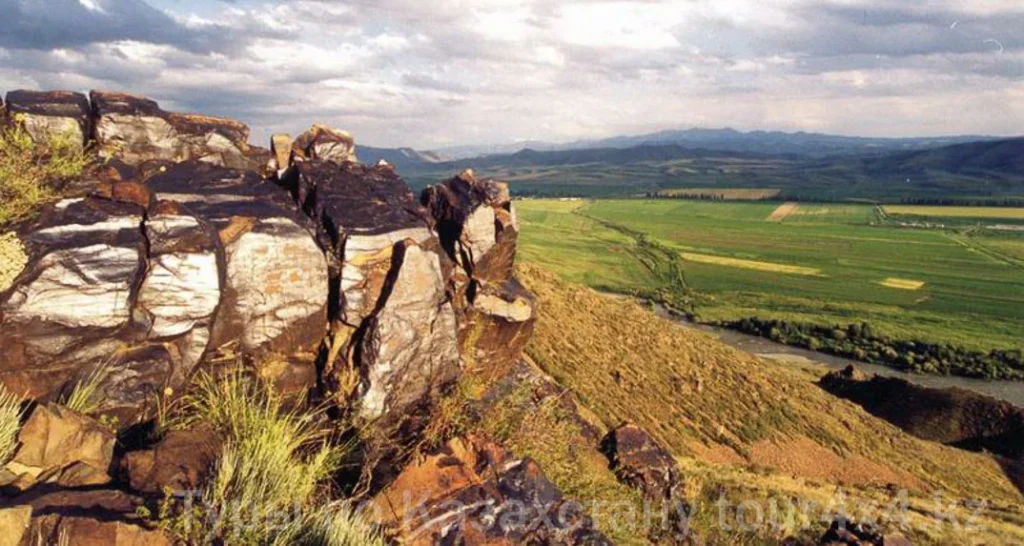
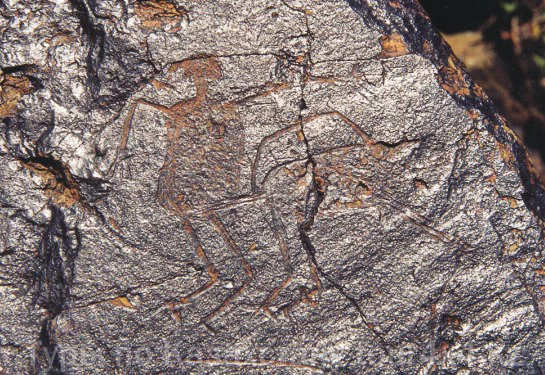
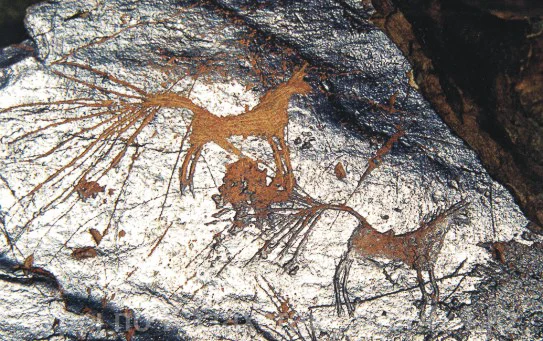
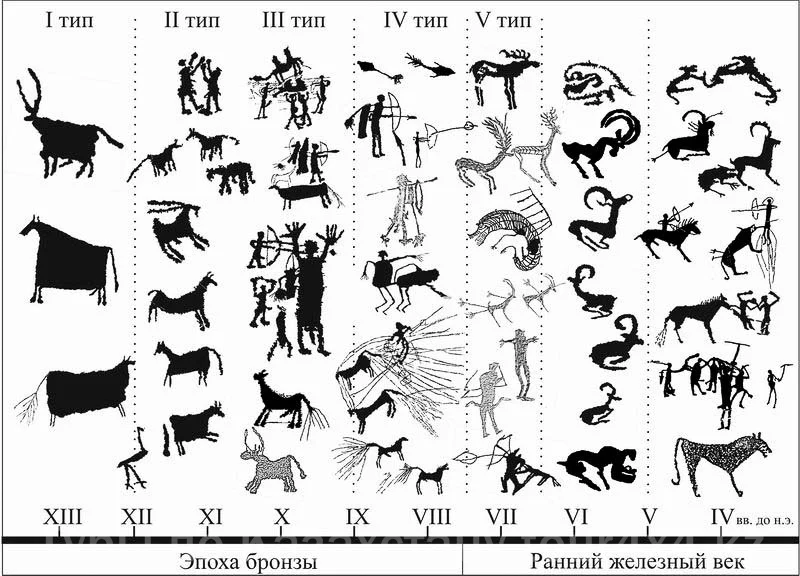
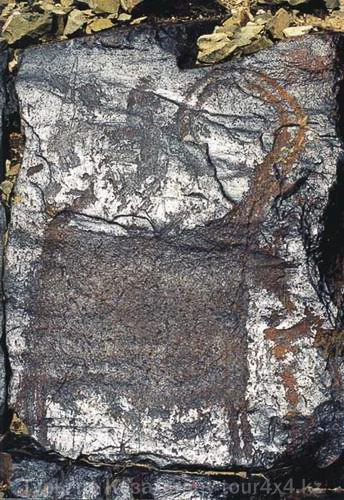
 The earliest series of petroglyphs is the least numerous; single images and simple compositions are more often found on the eastern periphery of the complex (gorges 13–15, 18). The repertoire is extremely poor, limited to images of conspicuously massive, “plump”, domestic animals – horse, goat, bull (Fig. 37). These drawings are often renewed, supplemented with new elements and incorporated into eclectic compositions of later periods. Within the Bronze Age, all the changes in the petroglyphs of this series are apparently connected with the periods of the wide spread of the engraving technique and of the creation of drawings of types III, IV and V.
The type II petroglyphs are more numerous and form the primary decoration of the main sites (gorges 10, 12) and of a number of peripheral points. The manner of depicting animals has much in common with the type I petroglyphs; the differences are apparently connected with the search for artistic means of conveying dynamics and expressiveness and are innovative in character. In general, this is a large series of petroglyphs, and more or less independent variants of images can be identified within it. At present, one of these groups of drawings is distinguished by us as type III, mainly on the basis of stratigraphic observations, since the stylistic differences are barely perceptible. The type II and III petroglyphs very often merge very harmoniously into unified compositions. At the same time, the way some images overlap others has nothing in common with the deliberate, demonstratively crude palimpsests of the Saka and Ancient Turkic periods. In general, both groups of petroglyphs should be regarded as relatively different in time within the development of a single pictorial tradition.
A landmark phenomenon in the rock art of the Bronze Age was the mastery of the carving technique. Observations made in Yeshkiolmes allow us to speak of two ways in which the petroglyphs executed in the combined technique of pecking with engraving appeared here. The first of them, the evolutionary one, is demonstrated by individual type III petroglyphs, in which the carving technique was used in a limited way to depict various attributes of anthropomorphic figures and elements of animal figures. Most often, bows and the flight of arrows, bridles and details of chariots, as well as the manes of horses and the tassels on the tails of animals, were depicted in this way.
Simultaneously with the spread of the combined technique (or somewhat later), a specific series of type IV images appears on the rocks of Yeshkiolmes, stylistically close to the type III petroglyphs, but executed in a technically different manner and substantially different in repertoire. The basis of the drawing is now formed by a deep outline made with the point of a metal tool; the silhouette is also often executed in carved technique, sometimes in combination with pecking and subsequent grinding. Anthropomorphic figures are often only indicated by a thin engraved line, but along with such schematic drawings there are also very expressive images of warriors with various weapons. The battle equipment usually includes: a large bow of the simple type; a quiver of arrows widened at the bottom, hung behind the back in a vertical position; a battle mace with spikes or a sling (?), attached to the upper part of the quiver; in several cases javelins or spears are depicted. Images of arrows with detailed reproductions of tips of various types deserve special attention: of simple leaf-shaped form, leaf-shaped with spurs lowered from both blades, and triangular. The countless images of arrows with fletching and tips of different shapes – placed in bows, flying or piercing animals and people – become a favourite motif of the rock compositions. Apparently, to the same time belong many magnificent images of chariots, of archers shooting at a giant, as well as battle scenes involving foot warriors (Figs. 38, 39).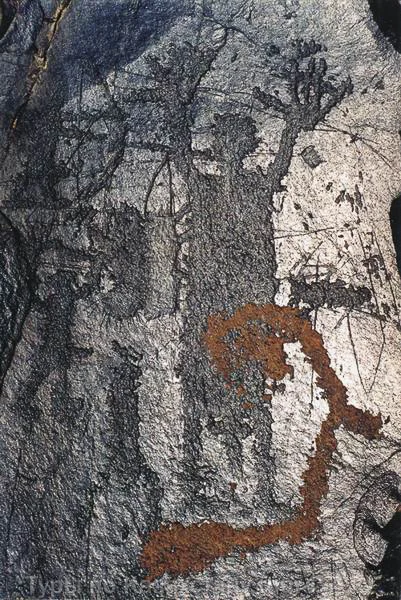 The appearance of this series of petroglyphs is connected with the first mass renewal and re-execution in the history of Yeshkiolmes of the rock images of preceding periods; the type III petroglyphs are “corrected” especially roughly. The technique of “correcting” earlier images was applied very widely, when the outline was re-emphasized with a deep carved line and new details were added to the drawing: the manes and tail tassels of horses, the hobbles on the legs of various animals, etc. In general, the phenomena captured on the rocks of Yeshkiolmes reflect a certain historical collision that affected, probably, not only the aesthetic or ideological sides of the life of the inhabitants of the Koksu River valley of the Bronze Age.
The next series of petroglyphs in order of creation, type V, also stands out distinctly for its artistic features and its pronounced “antagonism” to the rock works of preceding times. In this period the type III and IV images on the rocks of the main sites suffered especially: here is concentrated the largest number of palimpsests, of renewed and distorted petroglyphs. Apparently, the appearance in Yeshkiolmes of the images of the so-called “sun-headed” figures also belongs to this act of transformation. Practically all of them (including the known image of the “sun-headed” figure on a chariot) belong stylistically to the drawings of types III and IV, whereas the ray-lines and the hands were drawn later in carved technique in full accordance with the iconography and style of the anthropomorphic images of type V. A kind of “declaration” of the new canon being established are the palimpsests in which the earlier petroglyphs are overlapped by numerous arrows piercing the figures of people and animals. The main features of the type V petroglyphs are the dominance of the graffito and grinding techniques, laconicism and precision of graphics combined with a predilection for miniatures. Such qualities ensured the appearance of a whole series of very expressive images which can rightfully be ranked among the masterpieces of rock art. The images of wild animals – predators and herbivores – executed in the openwork style, or the miniature engravings, mark the appearance of a new artistic tradition organically connected with the art of the Sako-Siberian world. The external source (or sources) of this tradition is also indicated by the repertoire and the manner of depicting animals in the style of the deer stones of Tuva, Mongolia and Altai.
The cultural and chronological attribution of the identified groups of the most ancient petroglyphs of Yeshkiolmes can be carried out in retrospective order. For the type IV and V images, the innovative character of their origin and spread on the rocks of Yeshkiolmes is common, therefore the search for pictorial parallels and analogies to the realia represented in the petroglyphs leads beyond Semirechye, mainly to the north-eastern part of the steppe and forest-steppe zone of Central Asia.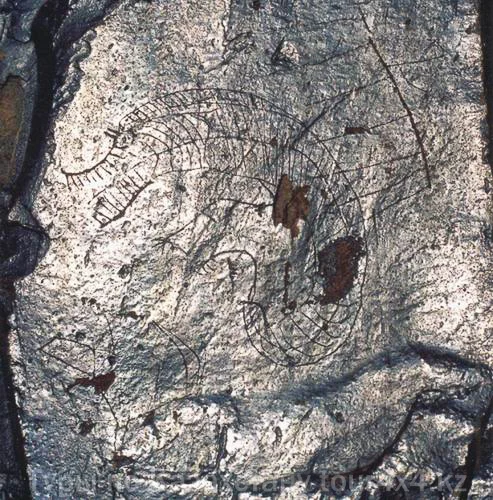 For the type V petroglyphs the diagnostic features are: 1) images of complex composite bows with straight or slightly curved ends; 2) the way of wearing the bow and the quiver for arrows – on the belt, at an angle, with the base of the case forward; 3) extremely schematic “plan-view” (after Ya. A. Sher; 1980) images of chariots with harnessed animals; 4) images of animals (elk, horse, bull-goat, predators curled into a ring) in the Arzhan style (after D. G. Savinov; 1998) and in the openwork manner, connected with the eastern area of the spread of type II deer stones (after D. G. Savinov; 1994); 5) a unique image of a wolf curled into a ring (Fig. 42), similar to the figures of predators on the mirror from the Shantsunlin burial (Varenov, 1984, Fig. 13, 2, p. 47-48). In general, the dating of the petroglyphs of this type on the rocks of Yeshkiolmes lies within the Early Scythian period, possibly the second half of the 8th – the middle of the 7th centuries BC.
For the cultural and chronological identification of the type IV petroglyphs, the following observations and comparisons are decisive: 1) the almost complete correspondence to the group of images of the Final Bronze Age of the 9th-8th centuries BC recently identified in the Altai (Russia and Mongolia) (Cheremisin, 1995b, pp. 75-78; Kovtun, 2001, pp. 134-135); 2) the limited area of distribution of the petroglyphs of this type, covering mainly the mountainous regions of the Altai (Dzhuramal, Kalbak-Tash, Tsagan-Salaa, etc.) and individual monuments dispersed at a great distance from each other in the Dzungarian Alatau and the Northern Tien Shan (Zhaltyrak-Tash; Miklashevich, 1995b, pp. 33-34, Fig. 1), among which Yeshkiolmes appears to be the most significant; 3) the absence in Yeshkiolmes of any other group of drawings directly preceding, “underlying”, the layer of the petroglyphs of the Early Scythian period; 4) the closeness in subject matter and style to the type III petroglyphs of the Late Bronze Age; 5) the absence of images of a composite bow; the archaic way of wearing the quiver and the bow vertically behind the back; 6) the “set” of arrowheads, including a) sub-triangular ones with lowered barbs (Yazdepe I, Lugavskoye; Kuzmina, 1966, p. 33, Table VI, 31, 42, 43; Avanesova, 1991, p. 44, Fig. 39, XVIII) and b) leaf-shaped ones with two barbs in the lower part of the blades, which have no analogies in the Andronovo monuments of the whole area; possible specimens in the nearest geographical surroundings are known in the Final Bronze Age monuments of Central and Eastern Kazakhstan (Varfolomeev, 1982, pp. 63-68, Fig. 4, 1; Maximova, Ermolaeva, 1987, p. 62, Fig. 21, 7), the forest-steppe Altai (Mylnikova, Papin, Shamshin, 2003, pp. 95-97, Fig. 2, 13), and also from the 7th century BC in the Tagar culture of the Minusinsk Depression (Chlenova, 1967, 41-45, Table 12, 20, 23).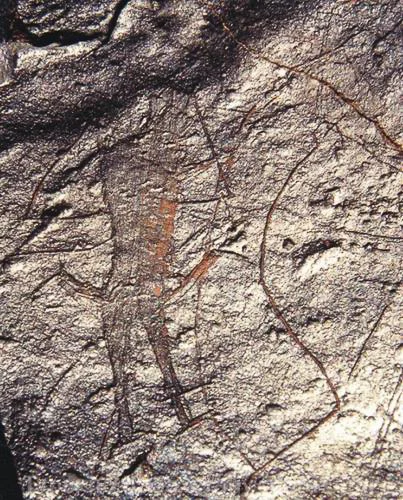 Thus, the appearance on the rocks of Yeshkiolmes of the type IV petroglyphs seems to be the result of a migration impulse from the north-eastern regions of Central Asia to Semirechye; the dating of this series of petroglyphs can at present be determined preliminarily within the 9th-8th centuries BC.
The type II and III petroglyphs together represent a single pictorial layer widely represented in monuments both in Kazakhstan and beyond its borders: Tamgaly, Karakyr, Kulzhabasy, Khantau (the Chu-Ili Mountains), Shomatai, Kylybai (the Kent Mountains, the Kazakh Upland), Dolanysai-Gabayevka, Arpauzen (Karatau), Cholpon-Ata, Zhaltyrak-Tash, Saimaly-Tash (Kyrgyzstan), Karakiyasai (Uzbekistan); the north-eastern boundary of the distribution of this group of images is possibly marked by individual series of the petroglyphs of Tarbagatai and Altai – Okey, Zevakino, Kalbak-Tash. Within the outlined area, local variants of the petroglyphs may subsequently be identified and their cultural and chronological position refined. For the monuments of Semirechye, the dating of this pictorial layer is at present determined on the basis of stratigraphic observations. In Tamgaly and Karakyr a series of palimpsests has been recorded in which images of the Tamgaly type are overlapped by the type II-III petroglyphs of Yeshkiolmes, the upper date of which is established within the 13th century BC. Taking into account the relative position of these images on the rocks of Yeshkiolmes, the chronological interval of the type II-III petroglyphs can be preliminarily designated within the Late Bronze Age – the 13th/12th-10th centuries BC.
The peculiar series of type I petroglyphs finds the closest analogies among the drawings of the Okey, Kalbak-Tash and Oglakhty III sites (the Minusinsk Depression), distinguished within the “geometric” pictorial tradition, the formation of which is dated to the last quarter of the 2nd millennium BC (Kovtun, 2001, 73-76, 136-138, Table 50, 6, 7, 10, 16).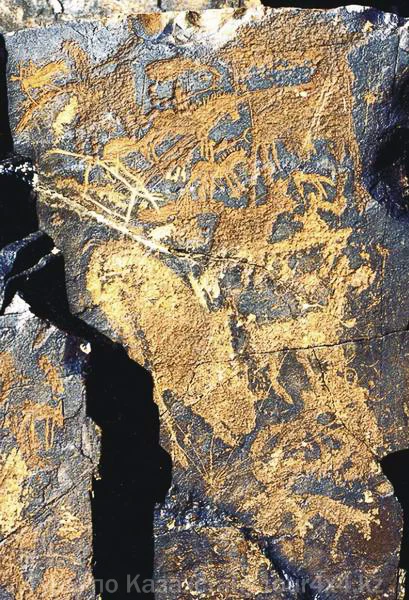 In general, the most ancient monuments of Yeshkiolmes reflect the main tendencies of the cultural and historical development of Eastern Semirechye in the Bronze Age (Karabaspakova, 1998, pp. 21-23). In rock art their content was determined by the interaction, at different stages, of two pictorial traditions, one of which acted as the local one, and the other as the incoming one. At the same time, at the early stage (type I) and later (types IV and V), the source area of the external impulse – the high-mountain zone of Altai and the south of Siberia – is clearly marked. For the cultural attribution of the main body of the Yeshkiolmes petroglyphs (types II and III), the wide spread of this pictorial tradition within the area of the Late Bronze cultures of Eastern Sary-Arka, Altai, Semirechye and the north-western Tien Shan is fundamentally important.
In an even more evident form, the noted interaction of different pictorial and cultural traditions is observed in the Early Iron Age petroglyphs of Yeshkiolmes. The dominant position on the rocks of the main sites belongs to a very expressive series of images executed in the artistic manner of the Early Saka animal style. At the same time, the central Bronze Age panels often remained untouched by the Saka artists, who preferred to create their compositions on “clean” surfaces, sometimes small and inconspicuous. The petroglyphs of this type are usually compactly located on the tops of the hills and on the passes; as an exception, the series of images on the rocks in the lower part of gorge 13, practically not used in the preceding epoch, should be singled out. Pecked images noticeably predominate, although the engraving technique continued to be used and reached exceptional perfection. The repertoire of the petroglyphs coincides entirely with the Early Saka triad of zoomorphic images: bird – hoofed animal – predator (Akishev K., Akishev A., 1983, p. 24), and on the basis of numerous analogies in Saka plastic art it is dated to the 7th-6th centuries BC.
Another group of the petroglyphs of the Saka period is formed by an equally vivid series of images which can confidently be connected with the art of the Pazyryk culture. These petroglyphs are found in Yeshkiolmes practically everywhere, but on the rocks of the main sites they are especially numerous. They are often included in the compositions of the Bronze Age, where they crudely overlap the ancient drawings. In the process of the “reinterpretation” of the subject, which as a rule consisted in adding several new key figures, the other drawings were also renewed and “corrected”.
A distinctive feature of the repertoire of the petroglyphs of this group is the leading role of anthropomorphic figures: mounted and foot warriors armed with bows, battle-picks, daggers or swords, hunting, fighting or simply brawling with their fists; but the central place, apparently, still belongs to the female image – the woman in childbirth. This is seen as a fundamental difference between the Saka animalistic rock art and the Pazyryk one. The zoomorphic images and motifs also have essential differences. The petroglyphs of this type, in addition to the characteristic stylistic features of the Altai animal style, are also distinguished by a specific iconography of the scenes of pursuit and of the tearing apart of herbivorous animals by predators, when the body or the head of the animal is turned 180° on its axis (Kubarev, 1999, pp. 85, 92, Table IV). In general, the dating of this series of images is determined within the 5th-4th centuries BC up to the beginning of the 3rd century BC.
It should be noted that a large number of images that are less expressive artistically and trivial in content also belong to the Early Iron Age on the rocks of Yeshkiolmes; they can be synchronized with the identified groups of petroglyphs or dated to a later period. However, at present their cultural identification and dating are hardly likely to be convincing.
A special stage in the development of rock art is illustrated by the petroglyphs of the Middle Ages. In Yeshkiolmes, as in Tamgaly and many other monuments of Central Asia, this historical epoch is associated with the mass renewal of the ancient petroglyphs and the “revision” of the content of the rock compositions. It should be noted that the changes affected to a greater extent the rock images of the Saka period, as being closer in content and style to the nomads of the Middle Ages. The most ancient petroglyphs suffered only to the extent that the images of the Late Bronze Age corresponded to the aesthetics of the equestrian epoch: the images of horses were supplemented with figures of riders, the images of wild animals were included in new scenes of hunting or herding; the other images, covered with dark patina, were merged into the general background and mercilessly overlapped by new drawings. Such an eclectic approach, however, did not exclude the creation of quite independent works. The repertoire is dominated by heroic themes, to which the realistically executed scenes of drive hunting should also be assigned. The engraving technique is successfully used to reproduce the smallest details of the warriors’ equipment and weapons. The most impressive compositions are concentrated in the main sites and in gorge 18, but on the whole medieval petroglyphs are found everywhere.
Among the petroglyphs of the Middle Ages, two groups of images are clearly distinguished: the Ancient Turkic one, dated by the realia and iconography to the 6th-8th centuries, and a later one, judging also by the realia, belonging to the 9th-11th centuries. On the whole, Yeshkiolmes remains the most vivid monument representing the medieval rock art of Semirechye (Maryashev, Rogozhinsky, 1991, pp. 26-31).
The drawings of the Modern and Contemporary periods make up a small group of the Yeshkiolmes petroglyphs compared with the other monuments of Semirechye and Southern Kazakhstan. On the rocks of the main sites their number is extremely small; mainly they are found along the mountain trails and near the settlement-winter camps of the 19th – early 20th centuries. The main number of Kazakh folk drawings and inscriptions of the second half of the 20th century is concentrated in gorge 18. The repertoire is limited to images of riders, domestic and wild animals; at the same time, in the hunting scenes, along with firearms, the bow and arrows are depicted; images of yurts and tribal signs (tamgas) are rare. The drawing technique and the methods of using the ancient petroglyphs are similar to those of the medieval ones.