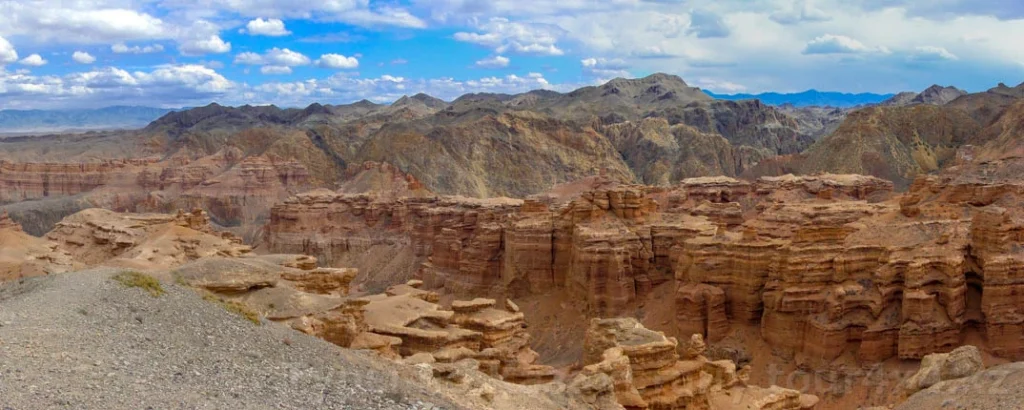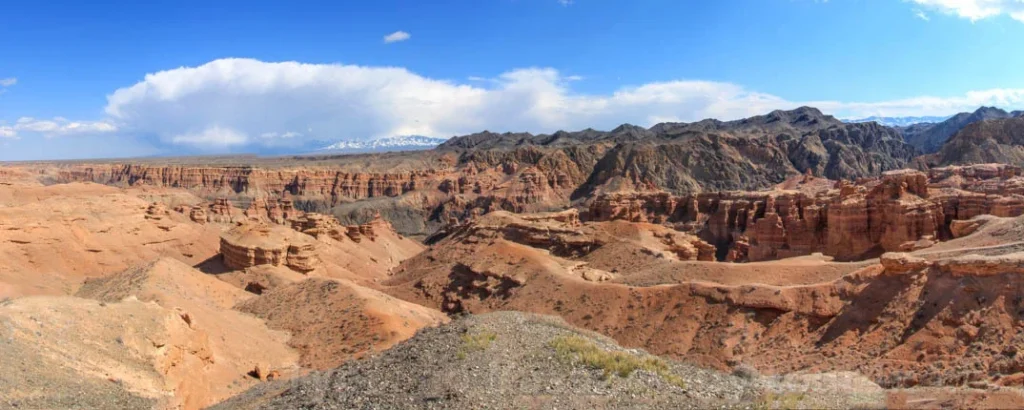
The Charyn River, the largest tributary of the Ili River, descends from the gorges of the eastern spurs of the Trans-Ili Alatau and rushes in a rapid stream for more than 350 kilometers. It bears different names along its course — in its middle reaches it is the Kegen, and only after merging with another mountain stream, the Karkara, does it become the Charyn.
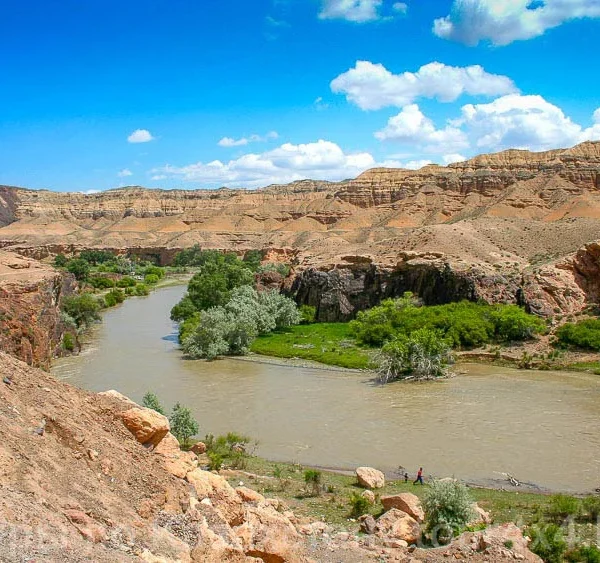 Over many millennia, this powerful river has carved a picturesque canyon along its entire length, but in recent years its best-known and most visited section has become the one aptly named the Valley of Castles. It is perhaps the most exotic creation of nature that can be visited from Almaty in a single day — and remain mesmerized by it for a long time.
Officially, the Valley of Castles is a wide, dried-out canyon some 3 kilometers long, adjoining the main riverbed. The river itself now flows along a different course, and millions of years ago this place was simply a bay of a giant ancient sea that stretched from present-day Lake Alakol to the Caspian. This explains the rather soft structure of the canyon walls — they are stones firmly compacted with clay, yet easily reshaped by wind and water. From this material, the great sculptor — nature — creates fantastic sculptures, both gigantic and tiny.
The trip to the Valley of Castles itself, located 200 kilometers from Almaty, gives the curious eye plenty of impressions — first you drive along a large part of the Trans-Ili Alatau ridge and see its highest, mighty, eternally white peaks, then pass through several large and small villages, each with its own special character. These trips are most often made in spring and summer, because in July and August life in the canyon stands still from the heat. Along the road you can see everything the villagers grow in this blessed land of seven rivers. Gradually the high mountains become flatter, wide valleys open up, and somewhere far to the north the blue ribbon of the Ili River occasionally flashes into view.
The last large village, with its rich and picturesque roadside bazaar, is Baiseit. Travelers often stop here to buy freshly baked flatbreads, vegetables and fruit, or simply to rest and stretch their legs after the long drive.
And finally, civilization is left behind, and you can pick up speed on the arrow-straight road. Then it bends toward the so-called Kokpek Canyon and winds among steeply rising rocky mountains. In spring they are very picturesque, covered with bright yellow sunrose bushes, poppies and wild irises.
Then comes the Kokpek Pass, a few small houses and a roadside cafe on the right, and you exit onto the final straight, which runs for quite a few kilometers. The boundless Sagetinskaya Valley, framed by distant mountains, spreads out on both sides of the road. Looking into the distance, it seems that groves are floating on water on the horizon — a kind of mirage, because as you approach, the groves take on their true form — they are mountains.
Seventeen kilometers after the split of the main highway (the road to the left goes to Khorgos, while straight ahead it goes to Narynkol — that is our road), there is a sharp left turn onto a dirt road. You will be shaken along it for a little over ten kilometers — and here you are.
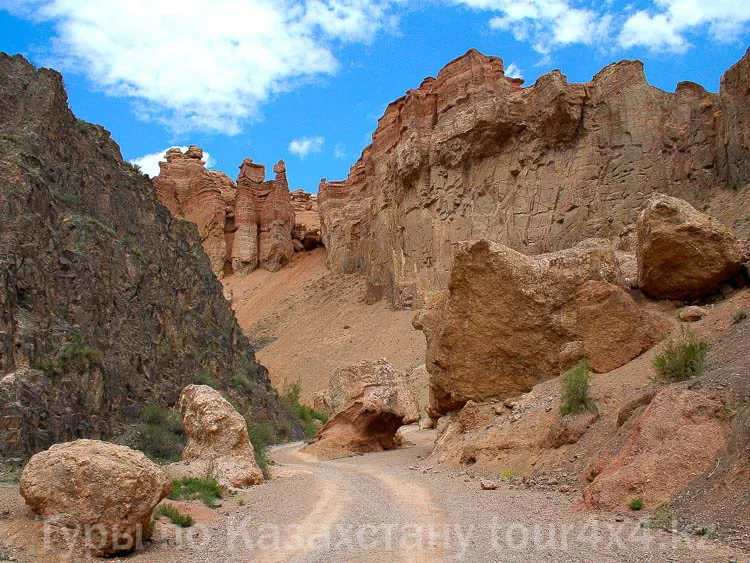
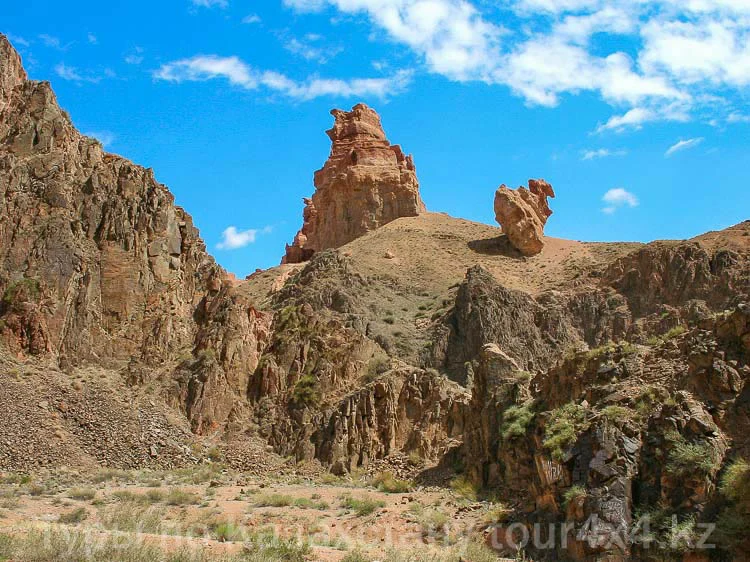
From afar the canyon is almost invisible — it looks like just another valley, and only when you approach the very edge do you see the narrow valley descending deep below, with walls of fantastic shapes. There are now several descents into the Valley of Castles, but once the first extreme tourists had to climb down on ropes until suitable descents were found. You walk down a steep path at the very beginning of the canyon and then along a road that gradually deepens into the valley. Almost immediately come the oohs and aahs, the exclamations, the hurried pulling out of cameras… And no wonder — the steep canyon walls are carved in a truly unimaginable way and have whimsical shapes in which everyone sees something of their own. Here a huge frog converses with a lizard, there a giant turtle, several meters tall, carries a load on its back, and over there a sharp-nosed giant has settled down to rest…
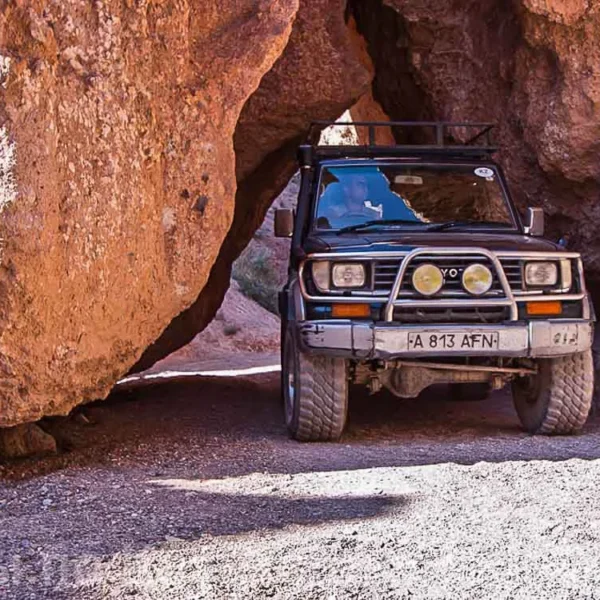 In places the canyon walls really do resemble the defensive walls of medieval castles. Overall, their height exceeds 100 meters. Then you pass through real gates formed by two enormous boulders, which once would not let motorists through. Only the laziest take no photos at these gates. Walking a little further, you will hear the soft murmur of the Charyn itself and the cool breath of its water.
All around are now true dark rocks, pitted with crevices and small caves, carved by the traces of spring water flows. At the very entrance to the round little valley of the river, high up on the right you can spot a funny figure created by nature — as if some unusual huge animal with a long nose stands on a thin leg, sadly waiting to collapse down… And when you walk back, everything you have seen will take on different shapes and look different.
The turbulent, powerful Charyn greets guests with a warning murmur — do not come close; if you fall in, there is no chance of rescue. At times you can hear it dragging large stones along the bottom. On the riverbank grow amazing trees — turanga poplars with leaves of different shapes. And on the other side of the river rise reddish walls resembling Chinese pagodas. Usually tourists have a snack by the river, rest, and head back.
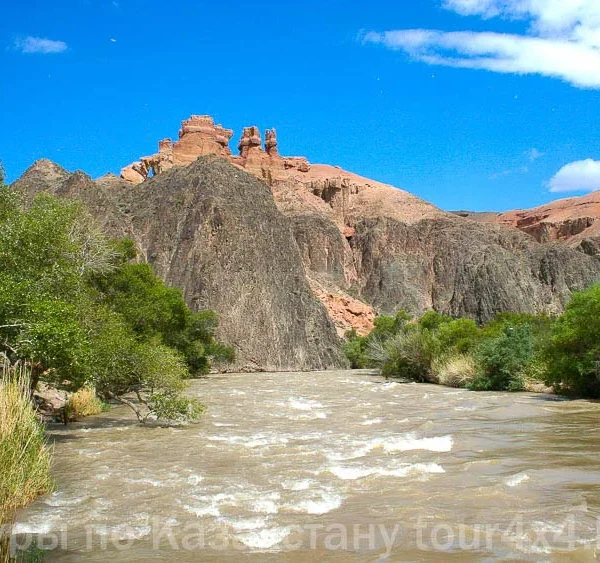
It is possible — but with great care and in a small group — to climb up the rocky path on the right side of the valley, if you look from the river. Even more interesting (and safer) is to exit the canyon via another trail that starts near the stone gates and is faintly visible on the slope. At first it runs almost parallel to the road, then gradually climbs upward. Everywhere there are burrows of gerbils, those small inquisitive creatures resembling large mice. They stand like little sentries by their burrows, diving quickly into them at the first sign of danger. They also build their colonies along the road to the canyon, at times digging a burrow right in the middle of the road — this is where they live.
As you climb out, do not forget to look back — the sight of the Valley of Castles lying at your feet will surely take your breath away.